The Montessori Shelf Rotation System That Keeps Toddlers Focused for 45 Minutes (Free Monthly Planner Inside)
By Sofia Carvalho
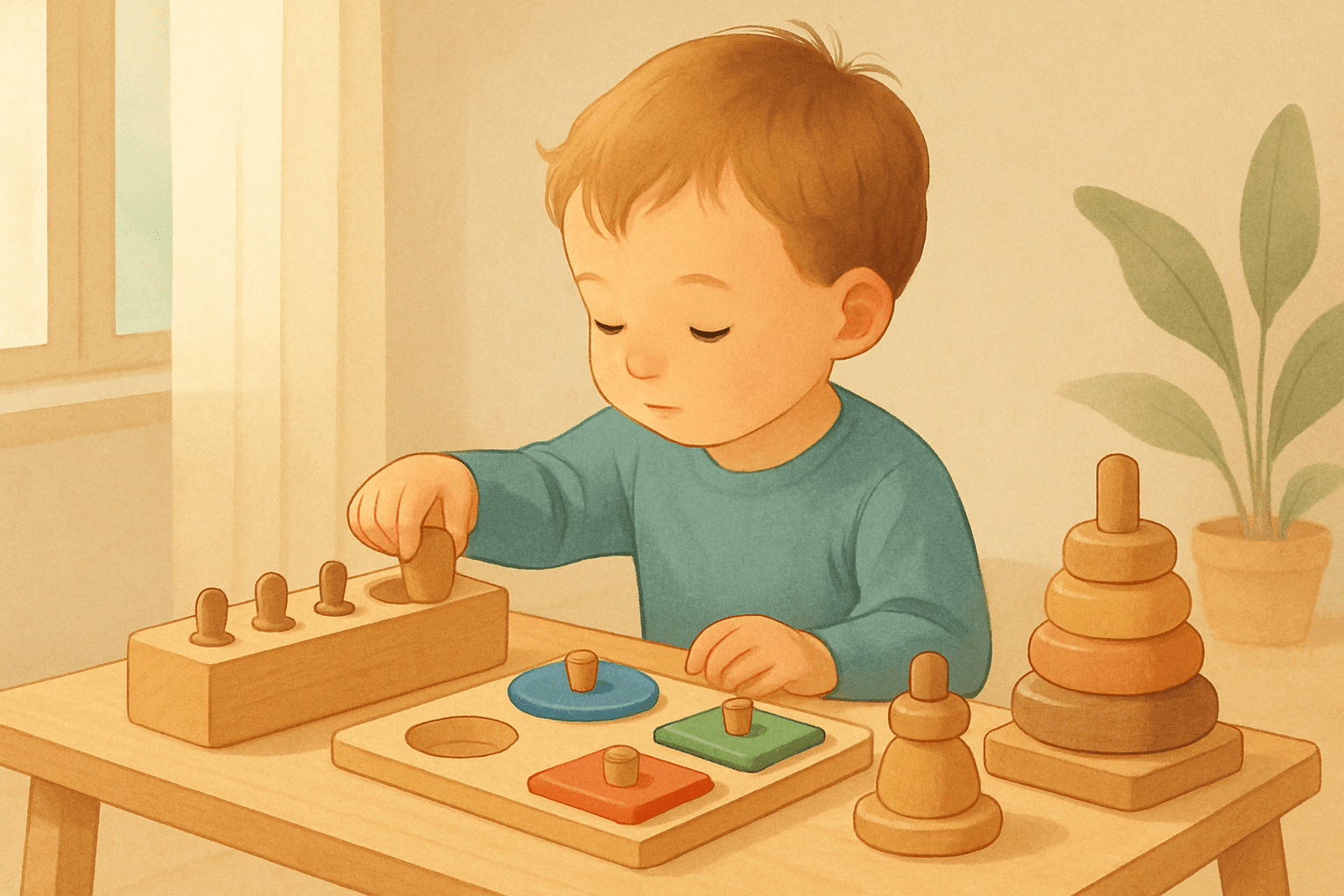
Your Toddler Is Ignoring the Shelf — And It Is Not Your Fault
If you have carefully arranged a beautiful Montessori shelf only to watch your toddler glance at it, pull everything off within thirty seconds, and wander away, you are not doing Montessori wrong — you are simply missing one crucial piece of the system. Montessori toddler shelf rotation ideas are rarely discussed in depth, yet rotation timing and presentation are precisely what separate a shelf that captivates a child for forty-five minutes from one that collects dust. You have already made the investment in materials and intention. This article gives you the framework to make that investment work.
I have guided hundreds of families through exactly this moment: the shelf is set, the basket is woven, the tray is beautiful, and the child is completely indifferent. What we discover together, almost every time, is that the shelf is not rotating frequently enough, the materials are not calibrated to the child's current sensitive period, or the presentation has lost its sense of invitation. All of these are fixable — and often quickly.
Why Toddlers Lose Interest in Shelf Work (The Science Behind the Frustration)
Novelty-Driven Attention Is Not a Bug — It Is Biology
Toddlers between eighteen months and three years are in one of the most neurologically active periods of human development. Their brains are wired to seek novelty as a survival mechanism — new stimuli trigger dopamine responses that reinforce exploration and learning. When the same materials sit on the shelf for three or four weeks unchanged, the toddler's nervous system has already catalogued them. There is nothing left to discover, and so attention naturally moves elsewhere.
This is not wilfulness or short attention span in the negative sense. It is your child's brain working exactly as it should. The Montessori shelf rotation system exists precisely to meet this neurological reality — to keep the environment one small step ahead of the child, offering just enough novelty to sustain engagement without overwhelming.
The Sensitive Period Connection
Dr. Montessori described sensitive periods as windows of time when a child has a particularly intense, almost compulsive interest in acquiring a specific skill or type of experience. Between ages one and three, toddlers move through overlapping sensitive periods for order, movement, small objects, and language. When a shelf material aligns with an active sensitive period, a toddler can work with it for astonishing lengths of time — that forty-five minutes of focused engagement is entirely realistic when the conditions are right.
When materials do not align with what the child's development is calling for right now, no amount of beautiful presentation will hold attention. Understanding your child's current sensitive period is therefore the foundation of effective montessori toddler shelf rotation ideas. For a deeper exploration of sensitive periods and how to spot them in your child, visit our guide on [Montessori sensitive periods in toddlers](montessori-sensitive-periods-toddlers).
The 3-Week Rotation Framework: A Practical System for Sustained Engagement
Most guidance on Montessori shelves tells you to rotate materials but never explains how often, how many, or which ones. The 3-week rotation framework addresses all three questions with a structure that is flexible enough to follow your child's lead while giving you a predictable rhythm to work within.
Week One: Introduce and Observe
In the first week of any rotation cycle, you introduce one to two new materials per shelf area. The shelf areas for a toddler typically include practical life, sensorial, language, and early mathematics. Place the new material in the most prominent position — ideally at the child's eye level and slightly forward on the shelf. Leave the remaining materials from the previous cycle in place during this week. Your role is almost entirely observational. Which tray does the child return to most? Which one is picked up and immediately put back? Which one prompts that deep, absorbed quality of attention that Montessori called the normalised state? Note these patterns without intervening.
Week Two: Consolidate and Extend
In the second week, remove the materials that received little to no interest and replace them with slight variations or extensions of whatever captured the most attention. If a colour-sorting activity with red and blue was the favourite, introduce a three-colour version. If a pouring activity was compelling, offer a pouring variation with a finer material like lentils instead of water. You are not introducing something entirely new — you are deepening the invitation along the line of interest the child has already revealed. This is the week when you are most likely to see that sustained, forty-five-minute concentration window emerge.
Week Three: Refresh and Prepare
By the third week, the child has thoroughly explored the materials on offer. Some will have become genuine favourites and can remain on the shelf indefinitely as anchors — familiar, mastered works that provide a sense of competence and comfort. Others are ready to be retired to storage. Use this week to observe again with fresh eyes and to prepare your next rotation cycle. Pull materials from storage, condition them if needed, and plan your next Week One introductions. This is also the week to consult your monthly rotation planner — more on that below.
The Shelf Audit Checklist: Diagnosing Why Your Shelf Is Not Working
Before any rotation strategy can succeed, the shelf itself needs to be functioning as an invitation. Run through this checklist honestly. Each issue includes a simple fix.
1. Are there more than 8 to 10 materials on the shelf at once? Fix: Remove everything that is not currently aligned with the child's active interest. A sparse shelf is far more inviting than a full one.
2. Is any material incomplete, broken, or missing a component? Fix: Audit every tray and basket weekly. A material with a missing piece communicates disorder and is quickly abandoned.
3. Are materials placed above the child's eye level? Fix: Lower the shelf or reorganise so that all materials sit between the child's shoulder height and knee height.
4. Are trays and baskets visually cluttered or mixed in colour? Fix: Use neutral-toned baskets and trays with a single material per tray. Visual simplicity is an invitation; visual clutter is a barrier.
5. Has the shelf looked identical for more than two weeks? Fix: Rotate at least one material per area every seven to ten days, even if it is simply a variation of an existing work.
6. Is the shelf in a high-traffic, noisy area of the home? Fix: Move the shelf to the quietest available corner. Deep concentration requires environmental calm.
7. Are you intervening or redirecting when the child is exploring a material unconventionally? Fix: Step back. A toddler transferring the lentils from the pouring jug into their pocket is still learning about quantity, material properties, and cause and effect. Observe before redirecting.
8. Is the lighting on the shelf flat or dim? Fix: Add a small lamp nearby or position the shelf near natural light. Warm, directed light makes materials visually appealing and signals that this is a special space.
5 Montessori Shelf Rotation Activities With Step-by-Step Instructions
The following activities are organised to give you concrete montessori toddler shelf rotation ideas that can be introduced across your three-week framework. Each is grounded in Montessori principles and calibrated for children between eighteen months and three and a half years.
Activity 1: The Treasure Basket Sensorial Rotation
Best for: Children 18 months to 2.5 years, sensitive period for small objects and texture
- Select a low, wide basket in a natural material — wicker or felt both work beautifully.
- Fill it with five to seven objects that are all the same colour but vary dramatically in texture: a smooth river stone, a rough piece of tree bark, a velvet ribbon, a small wooden disc sanded to silk, a metal spoon, a cork.
- Place the basket on the lowest shelf position with no other materials immediately beside it.
- In Week Two, change the colour theme entirely — all blue, all natural wood tones — and refresh the objects while keeping the basket itself familiar.
- In Week Three, introduce a simple sorting element: two smaller baskets inside the large one, with a visual cue (a coloured dot) suggesting where like-textured items might go.
Activity 2: The Graduated Pouring Sequence
Best for: Children 2 to 3.5 years, sensitive period for movement and coordination
- Begin with a simple dry pouring work: a small jug of large pasta shapes and a receiving bowl, on a tray lined with felt to catch spills.
- Demonstrate once, slowly, without narrating. Set it back on the shelf.
- In Week Two, introduce a pouring variation with lentils — a finer material requiring more muscle control.
- In Week Three, introduce water pouring with a small measuring jug that has visible graduated markings. The child is now not just pouring but reading quantity — an early mathematics concept emerging naturally.
- Always photograph the complete, reset tray before placing it on the shelf so you can restore it exactly after the child's work.
Activity 3: The Sound-to-Object Language Basket
Best for: Children 2 to 3 years, sensitive period for language
- Gather five miniature objects whose names begin with the same initial sound — for example, a small snake, a spoon, a star, a stone, a piece of sponge.
- Place them in a small wooden bowl or cloth bag on the language section of the shelf.
- In Week One, simply allow the child to explore and handle the objects. Name them naturally in passing if the child holds one up toward you.
- In Week Two, add a set of simple picture cards — hand-drawn or printed — showing each object. The child can begin matching object to image.
- In Week Three, introduce a second sound family and allow the child to sort between the two bowls. You have just introduced the earliest Montessori phonics concept without a worksheet in sight. For more ideas along these lines, see our article on [Montessori activities for 2-year-olds at home](montessori-activities-for-2-year-olds-at-home).
Activity 4: The Practical Life Folding Progression
Best for: Children 2.5 to 3.5 years, sensitive period for order and fine motor refinement
- Select three identical cloth napkins in a neutral colour and a small basket.
- Fold one napkin in half and place it in the basket as a visual model. Leave the other two unfolded beside it.
- Demonstrate folding once along a visible crease line — you can use a fabric marker to draw a faint dotted line as a guide.
- In Week Two, introduce the quarter fold, demonstrating twice maximum.
- In Week Three, present a small ironing board and a cool iron (supervised) for the child who is showing readiness. The progression from folding to ironing is one of the great practical life sequences in Montessori — it moves from gross motor to fine motor to genuine household contribution, which deeply satisfies the toddler's drive to participate in real work.
Activity 5: The Bead Counting and Colour Sorting Math Tray
Best for: Children 2.5 to 3.5 years, early mathematics and sensitive period for small objects
- Prepare a tray with a small bowl containing fifteen to twenty large wooden beads in three colours (five of each) and three smaller bowls.
- Place a coloured dot sticker on the bottom of each small bowl corresponding to one bead colour.
- Allow the child to sort beads into matching bowls. The self-correcting nature of the work (an equal number in each bowl) provides its own feedback.
- In Week Two, add a simple set of number cards: 1, 2, 3. The child places the corresponding number of beads beside each card.
- In Week Three, replace the dot sticker cue with a written numeral on each bowl. The visual prompt remains, but it is now abstract rather than concrete — a natural bridge toward symbolic mathematics. For material recommendations at this stage, see our guide to [the best Montessori toys for ages 2 to 4](best-montessori-toys-age-2-to-4).
Your Free Printable: The Montessori Monthly Shelf Rotation Planner
One of the most consistent things I observe in families who struggle with montessori toddler shelf rotation ideas is not a lack of good intentions but a lack of a visible plan. When the rotation lives only in your head, it is easy to forget where you are in the cycle, which materials were already tried, and what is ready to be introduced next.
The Free Montessori Monthly Shelf Rotation Planner was designed to solve exactly this problem. It is a printable four-week calendar designed to be pinned directly above your child's shelf — not hidden in a binder — so that the plan is always visible and easy to update.
Here is what is included in the planner:
- A four-week grid with thirty pre-planned activity slots, organised by Montessori shelf area: practical life, sensorial, language, and mathematics
- A weekly rotation tracker with columns for 'introduced,' 'observed interest,' 'extend or retire,' and 'notes'
- A sensitive period reference strip along the bottom margin listing the key sensitive periods for ages 18 months to 3.5 years so you can quickly cross-reference your child's current behaviour
- A blank 'next rotation' planning column so you can note materials to pull from storage while the current cycle is still running
The planner prints on two A4 or letter-size pages and works beautifully laminated with a dry-erase marker for month-to-month reuse.
You'll find free printable worksheets for this topic in our printables library below.
The Right Tools Make the System Sustainable
No rotation framework survives long without the right physical materials. One resource I recommend consistently to families at the intermediate Montessori stage is the Monti Kids Level System — a subscription-based Montessori material set that is sequenced by developmental stage and includes a parent guide explaining the purpose and presentation of each material. What I particularly appreciate from a Montessori perspective is that the sequencing is grounded in sensitive period theory, which means the materials arriving in each level genuinely align with what the child's development is calling for at that time. It removes much of the guesswork from the rotation process and is especially useful for families building their home shelf environment from the beginning rather than purchasing materials individually.
If you prefer to curate your own shelf materials, our reviewed guide to [the best Montessori toys for ages 2 to 4](best-montessori-toys-age-2-to-4) includes a curated selection with notes on which developmental stage each material serves best.
Before and After: What a Rotation Actually Looks Like
Before: The Static Shelf
Imagine a shelf with the same eight materials that have been in place for four weeks. The practical life section holds a spooning activity with dried chickpeas that the child mastered in week one. The sensorial section has a colour box that was briefly interesting but now goes untouched. The language section has a set of alphabet cards the child is not yet developmentally ready for. The math section has a number puzzle that is slightly too challenging with no bridge material to scaffold toward it. Every material is in exactly the same position it has always been in. The shelf looks tidy but feels static. The child walks past it.
After: The Rotating Shelf
The same shelf, refreshed using the three-week framework, looks like this. The practical life section now offers the graduated pouring sequence — familiar enough to feel safe, novel enough in material to engage. The sensorial section holds a new treasure basket in warm autumn tones with five objects the child has never handled. The language section has the sound-to-object basket with the initial sound family the child has been spontaneously making during play. The math section has the bead sorting tray at exactly the right level of challenge. One material per section is slightly forward of the others, catching the light. The child enters the room, pauses at the shelf, reaches for the pouring tray, and works for thirty-seven minutes without interruption.
The difference is not the materials. The difference is the system.
A Gentle Reminder About Pace
Montessori at home is not a performance, and a toddler who works for ten minutes on a tray is not a failure — ten minutes of genuine concentration in a two-year-old is neurologically remarkable. The forty-five minute benchmark is a real possibility when conditions align, not a minimum standard to meet. Some days your child will sweep everything off the shelf and that is data, not defeat. Observe it, note it, and let it inform the next rotation.
Trust the environment over the instruction. Trust the child over the plan. Your role in the Montessori home is preparation and observation, and you are already doing both by reading this far.
Conclusion: The Shelf Is a Living Environment — Treat It That Way
The most important shift that intermediate Montessori parents make is recognising that the shelf is not furniture — it is a prepared environment that requires active, thoughtful stewardship. Montessori toddler shelf rotation ideas are not a one-time project but an ongoing, responsive practice that grows with your child.
The 3-week rotation framework gives you a rhythm. The shelf audit checklist gives you a diagnostic tool. The five activities give you a starting library. And the free monthly planner gives you the visible, pinned-to-the-wall structure that makes the whole system sustainable over months and years rather than days.
You have not wasted your investment in materials. You have simply been waiting for the system to meet them. Now you have it.
For more Montessori home environment guidance, weekly activity ideas, and sensitive period updates as your child grows, subscribe to the SparklingLearners newsletter. A new article for Montessori families arrives every week, written with the intermediate parent in mind — because you have moved past the basics, and your reading material should too.
Free Printables for This Topic
Browse our free printable worksheets and activity pages for this age and topic.
Get Free Printables Delivered
Get a free starter pack + weekly activity ideas, straight to your inbox.